
One of the most human of our characteristics is that we simply love to see patterns. Often these patterns exist only in our minds but our natural desire to reach conclusions even with the tiniest amount of information to hand forces us to add 2 and 2 and make several.
Nowhere is this inclination better reflected than in our insistence that ‘the league table doesn’t lie.’
There is some merit in this suggestion of course; after 38 or 46 games the final Premier League or Championship tables are a pretty good indication of strength and just desserts. But the period from October to January is when most of the important decisions are made by clubs regarding their performance compared to their expectations.
Managers are summarily relieved of their duties after fewer and fewer games each season but more scientific analysis of their performance would often yield a very different conclusion.
Such analysis can be carried out using ‘expected goals.’
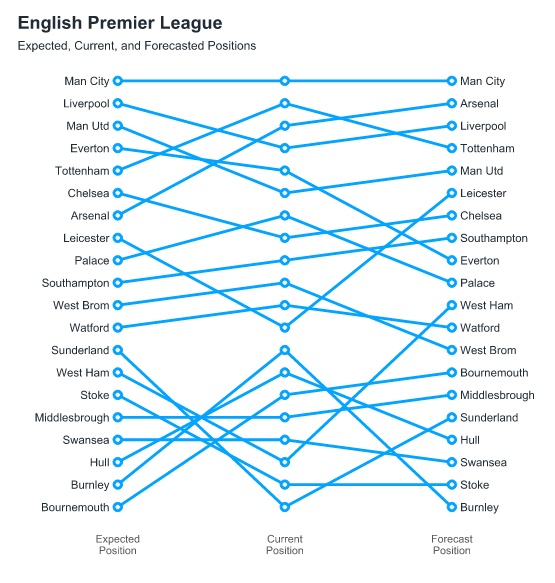 The concept of expected goals is a controversial one. Managers dispute the very nature of the term, owners and chairmen are unconvinced and even the analysts can’t agree on the most effective measure. But none of this really matters.
What matters is that after a handful of matches with inevitably very uncertain outcomes, little can be soundly determined simply by the snapshot of results provided by a league table.
The nature of football is that a heavy reward is applied to a tiny number of events (goals) and the final score regularly bears little relation to the strength or the just desserts of each team.
Consequently, to reach sound conclusions you need plenty of data. It’s understandable that clubs bow to the pressure of financial judgment and take action earlier and earlier if their team fails to measure up to expectation but the dubious wisdom of such decisions is highlighted by a different perspective on league tables such as that considered here.